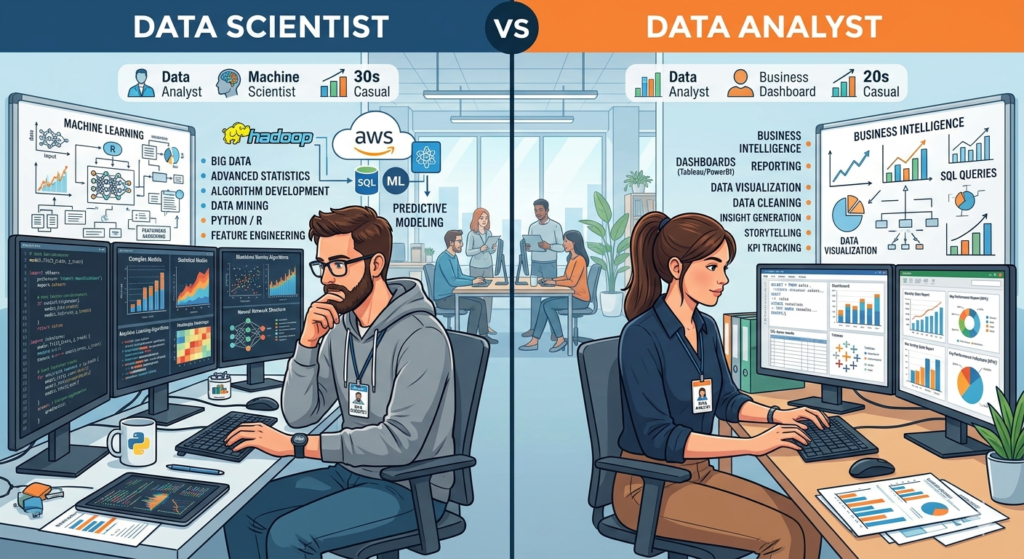

If you go into the realm of facts, there is often often one question that comes up first: Data Scientist vs Data Analyst — which profession do you need to choose?
At first glance, each role sounds comparable. They are confronted with records, numbers, and insights. But in truth, they range sharply in competencies, income, equipment, and long-term career boom.
By 2026, the demand for fact experts is exploding—pushing AI, automation, and digital transformation. According to LinkedIn Jobs on the Rise and other enterprise reviews, both roles are a number of the fastest growing careers globally.
So, how do you decide which one to start with?
This guide breaks down Data Scientist vs Data Analyst at its best—so even beginners could desire assured.
What is a Data Analyst?

A statistical analyst is an expert who collects, methods, and interprets data to help organizations make smarter decisions. In easy phrases, information analytics provide essential insights from raw data that groups can use to enhance overall overall performance, understand customers, and plan destiny strategiesfind internal big datasets hidden in styles and trends. This makes the role of data analyst one of the most in-demand career options for beginners entering the information field.
Key responsibilities of a data analyst:
A Data Analyst’s each day of images includes a mix of technical and analytical tasks, which include:
•Clean and organize records: To ensure accuracy of data and remove errors, duplicates and inconsistencies
•Analyzing data sets: Exploring data to identify developments, correlations, and patterns
•Creating dashboards and reviews: Presents insights using charts, graphs, dashboards and other gear
•Answering enterprise questions: Helping organizations understand “what’s happening” and “why it’s miles away”.
•Supporting selection-making: providing record-assisted insights into manual enterprise techniques
Tools commonly used through Data Analysts
•Excel: For basic analysis, data correction, and small calculations
•SQL: To extract and control facts from a database
•Power BI / Tableau: To create interactive dashboards and visual reports
•Python (fundamental platform): Using libraries like Pandas and NumPy for fact manipulation and evaluation
How to Understand a Data Analyst?
Think of a Data Analyst as a storyteller who uses statistics over words.
What is a data scientist?

A data scientist is a professional who goes beyond primary fact analysis to find deeper insights and build intelligent systems that can anticipate fateful outcomes. Instead of just exploring what has already passed, a Data Scientist uses superior tactics such as system mastering, statistics, and programming to answer forward-looking questions
In easy phrases, a Data Scientist turns raw records into actionable forecasts and smarter choices that help groups grow.tt
For example, corporations like Amazon or Netflix use information scientists to suggest products or movies based entirely on your behavior. This is where fact technology is effective—it doesn’t just provide an interpretation of the other, it shapes the future.
Key responsibilities of a data scientist:
•Building a fashion knowledge acquisition machine to automate decision making
•Forecasting future developments that include customer conduct or income growth
•Analysis of large and complex data sets (Big Data) .
•Cleaning and preparing data for evaluation
•Building algorithms and data-pushed solutions
•To communicate insights to stakeholders in a simple way
Tools commonly used through Data Scientists:
•Python / R for programming and statistics analysis
•Machine Learning libraries like Scikit-examine and TensorFlow
•SQL for handling structured reports
•Big Data tools like Hadoop or Spark
•Deep expertise frameworks for better AI models
How to understand a data scientist?
Think of a Data Scientist as someone who doesn’t just examine data—but uses it to expect what will appear next.
Average Salary in India (Data scientist vs Data analyst)
| Experience level | Data analysts | Data scientists |
| Freshers (0-1year) | ₹3 – ₹6 LPA | ₹6 – ₹10 LPA |
| Intermediate (2-5 years) | ₹6 – ₹12 LPA | ₹10 – ₹20 LPA |
| Experienced (5+ years) | ₹12 – ₹18 LPA | ₹20 – ₹40+ LPA |
Investigation:
Although Data Scientists earn more, the barrier to entry is just as good. Many specialists start out as analysts and later transition.
Check out systems like Glassdoor India or AmbitionBox for recent revenue trends.
Skill Comparison(Data scientist vs Data analyst)
| Data Analyst | Data Scientist |
| SQL (Must have) | Python/R programming |
| Excel & Dashboards | Machine Learning |
| Data visualization | Statistics and probability |
| Basic stats | Data Engineering Fundamentals |
| Communication | Problem solving mindset |
Career Path: Data Scientist vs Data Analyst — Which Should You Choose?
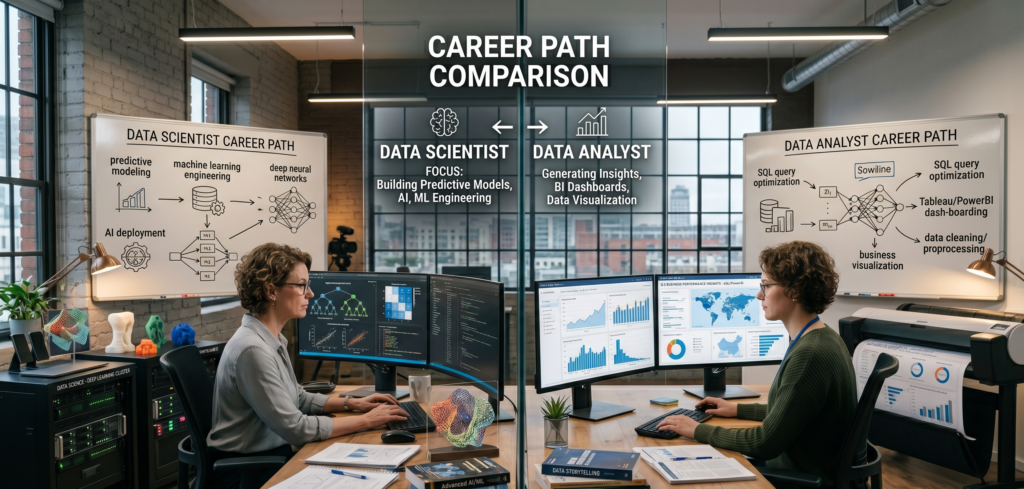
Choosing between Data Scientist vs Data Analyst can feel confusing, especially when you’re just starting your journey within the data field. Both roles are high-calling, both offer top-notch pay, and both can result in exciting careers. But the right preference depends on your modern-day skills, tools, and the way you need to move quickly to the enterprise.
Select Data Analyst if:
Starting as a Data Analyst is often the neatest and most practical access point for newbies.
You are an amateur in tech or facts.
If you’re just starting to get to grips with Python, Excel, or SQL, the Data Analyst role is much more approachable. It does not immediately require in-depth information on machine expertise or complex algorithms.
You want faster activity entry
In evaluating data scientists versus data analysts, the roles of the analyst are less complicated to land brilliantly. Companies hire analysts extra often because every commercial enterprise wants reports and insights.
You enjoy visualization and storytelling
If you like turning raw records into meaningful charts, dashboards, and enterprise insights, you’ll find this work rewarding. It’s much less about coding, and extra about interpreting records in a simple way.
You decide on less coding and more practical diagrams
While coding is still beneficial, most of your pictures have tools like Excel, SQL, and Power BI as opposed to heavy programming.
Take a look at the reality of Data scientist vs Data analyst:
Many successful Data Scientists did begin their careers as Data Analysts. It helps you build a strong foundation without feeling crushed.
Select Data Scientist if:
If you aim well and are ready for the mission, becoming a Data Scientist can be exceptionally rewarding.
You experience math, information, and logical questions.
This is the most important differentiator in the Data Scientist vs Data Analyst discussion. Data science requires a strong knowledge of probability, information, and mathematical principles.
You are ready to analyze Machine Learning and AI.
This work goes beyond data analysis—you’ll build a model that expects a fate effect. If ideas like neural networks or algorithms excite you, this is the direction for you.
You want good long-term income and boom
Data scientists often earn more because of their particular skills. But this comes with a longer learning curve and better expectations.
You’re k with a steeper to know the curve.This path is not concise or smooth. It calls for staying power, ceaseless dexterity, and enjoying real-world work.
Real-world career insights for Data scientist vs Data analyst
Here’s a fact most publications bypass when evaluating Data Scientist vs Data Analyst:
👉 Many successful Data Scientists don’t start there—they start as Data Analysts.
This is not a shortcut. It’s in reality the nitest and maximum practical direction, especially for newbies. Why starting as a Data Analyst works so well When you begin your journey within the Data Scientist vs Data Analyst pathway as an analyst, you build a strong foundation that many aspiring statisticians abandon: You will undoubtedly take notice Not just fashionable, yet messy, real-international data—cleaning it, exploring it, finding meaningful patterns. You grow commercial enterprise thinking You learn how corporations absolutely use records to choose, not just how algorithms picture. You settle the venture quickly Data Analyst roles are more beginner-friendly, allowing you to enjoy the benefits and benefits of landing your first job.
👉Read next :Python for beginners: What you should learn first in 2026
Choosing between Data Scientist vs Data Analyst doesn’t have to be hard. Start in the one you are in. If you are an amateur, the neatest move is: ➡️ Start with Data Analysis ➡️ Build confidence ➡️ Gradually circulate in data science This way you avoid crushing and build a strong foundation.
I would love to pay your attention now . Are you planning to grow as a Data Analyst or Data Scientist? Drop your answer in the comments—and if you found this guide beneficial, share it with a friend who is concerned about Data Scientist vs Data Analyst. Also, don’t overlook searching for additional begginer-friendly guides on Data science to begin your journey .