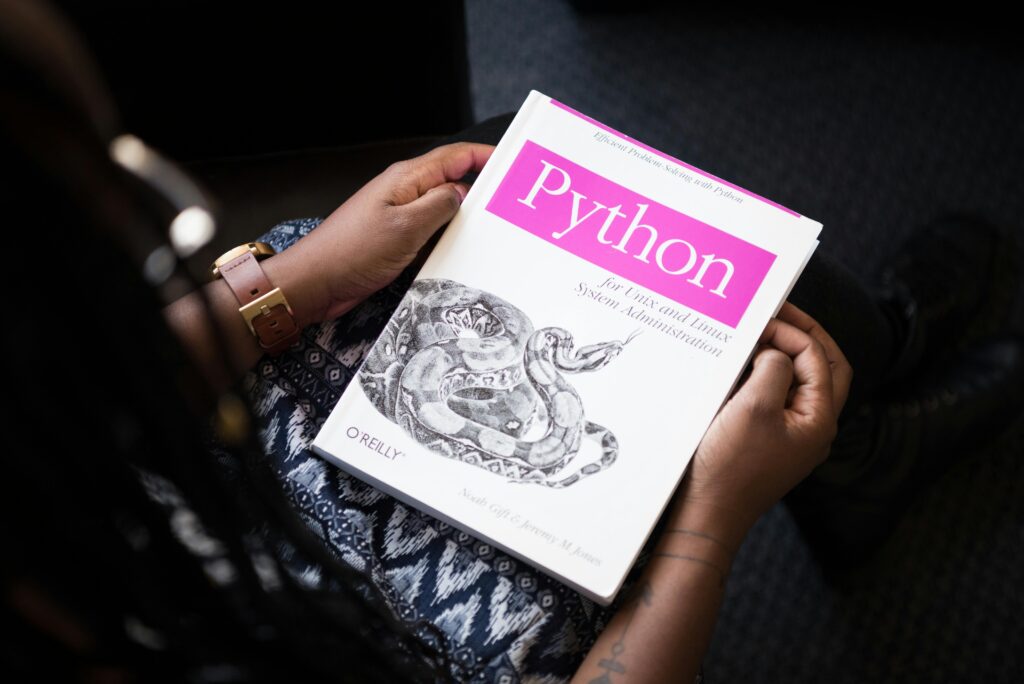

Python is the most used and famous programming language in the world today. For anyone who is new to programming python is the best option, python for beginners is often the best place to start. Python is easy-to-read syntax and wide range of applications make it ideal for learning the fundamentals of coding. In this Python for beginners guide, you will learn all the concept of python that is important for beginners. If you are the beginner and planning to start coding now this guide Python for beginners is for you and this will help you a lot in your coding journey. Python for beginners guide will help you to learn from basic syntax and variables to loops and functions. Make sure you read and understand this guide python for beginners till the end.
Why python for beginners is the best programming language to start with?
Almost everyone suggest to learn Python as a beginner, but why? Why is python always recommended for beginners? Lets talk about it in this Python for beginners guide. One of the main reasons Python for beginners is highly recommended is its simple and readable syntax. Mostly coders struggle with complicated code, and here python becomes perfect as it uses a clean and easy-to-understand structures that allows coders to focus on learning and not struggling with complicated code.
One of the biggest advantage of Python for beginners is its clean and readable syntax unlike other programming languages. In python there is less rules and regulations of writing code as it uses simple commands that are easy to understand, allowing new programmers to focus on learning programming concepts instead of worrying about complex rules and structures.
Most of the time beginners find problem while coding and mostly they search for tutorials or blog articles related to the problems and here is another why Python for beginners is highly recommended is the large community support. Since Python is widely used across the world, beginners can easily find tutorials, guides, solutions and blog articles to their coding problems online.
Setting up python for beginners
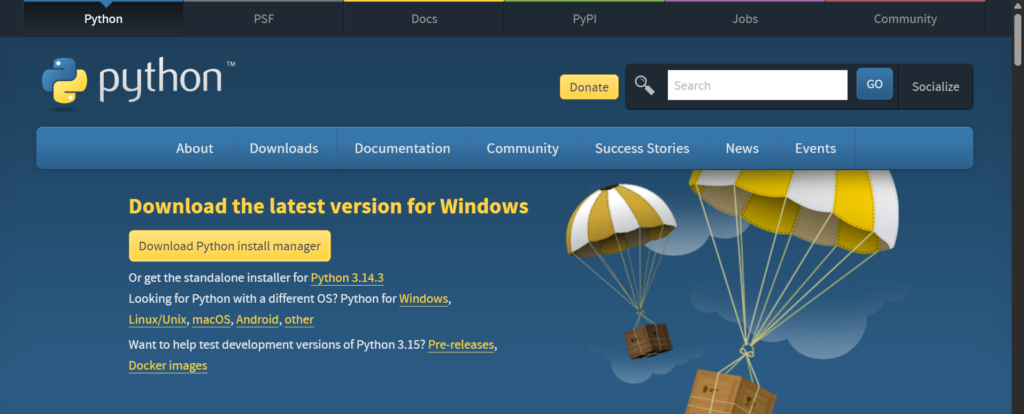
Python is a programming language and for writing code in python, first we need to setup python. The first step in Python for beginnersis setting up right tools on your computer. Next step in Python for beginners is to install Python itself in your computer. To do that, just open any browser on your computer and search Python and just download it or click here.
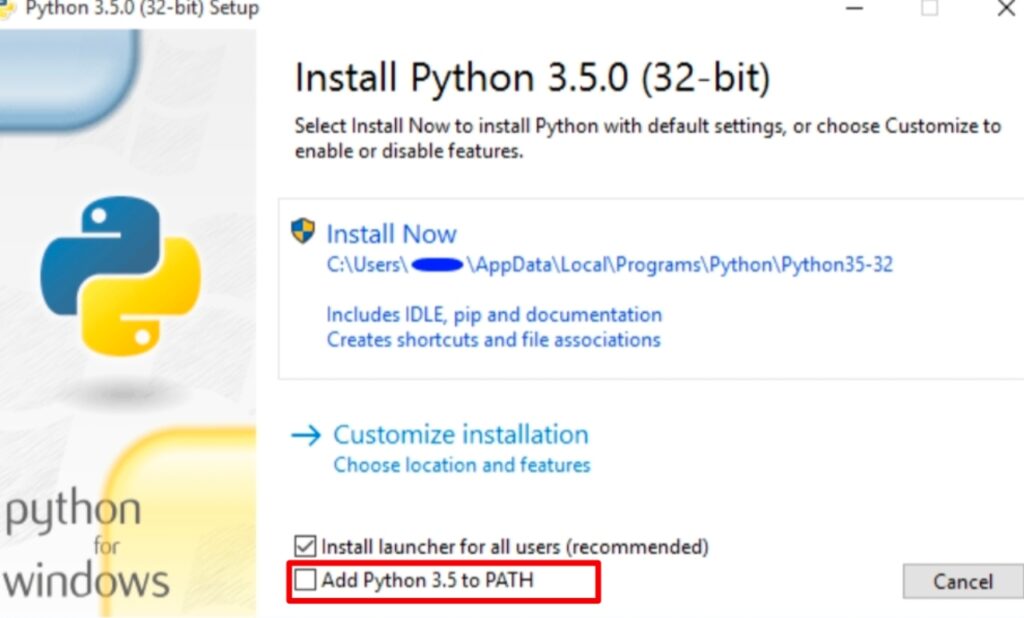
After downloading, while installing python make sure to tick mark the option “Add Python to PATH” so that you can run python from the command prompt. You can just see the image bellow and follow it so that you don’t make any mistake while installing Python.
After installing python you just need a code editor. Python is a programming language and to write and run programs we need a platform which is called code editor. Code editor is nothing but a platform where we can write and run code. There are so many code editors, you can use one of them but we will highly suggest you to use VS Code (Visual Studio Code) as it is very popular and easy to use and it is best for beginners.
Two popular editors used in python for beginners are:
Visual Studio Code(VS Code)
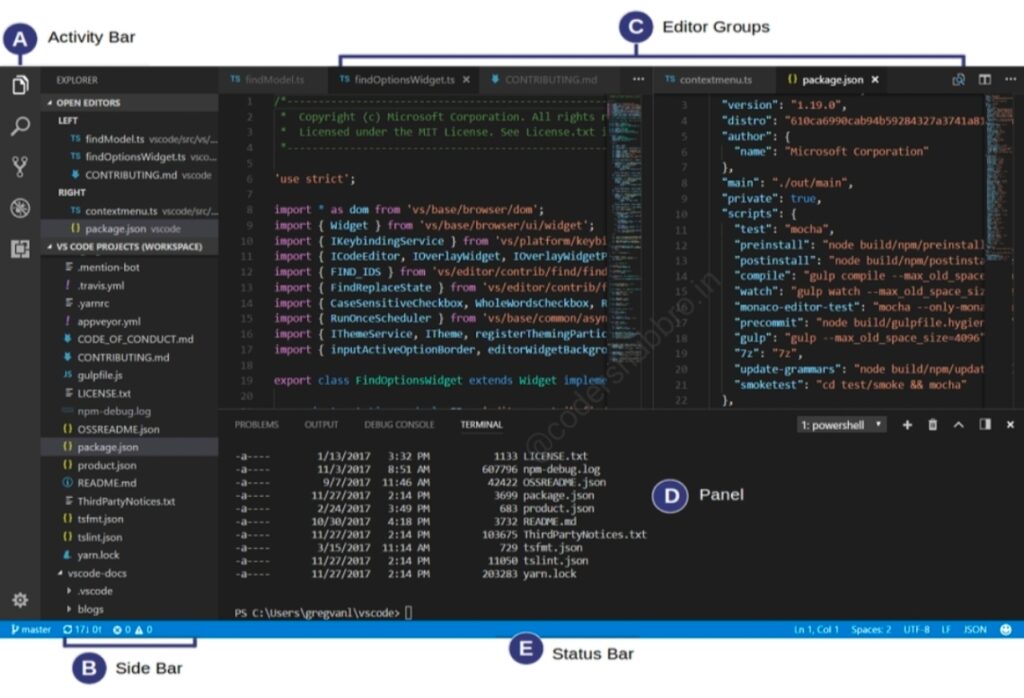
This is the most used code editor by the programmers as it is very lightweight and powerful editor. It has many extensions that helps programmers to write clean code. It has useful extensions specially for python. VS code is developed by microsoft and is widely used in python for beginners as well as professional development. It also provides useful features like syntax highlighting, auto completion, debugging tools and extensions that make coding easier and more efficient. To use VS Code, visit google or click here and download it.
PyCharm
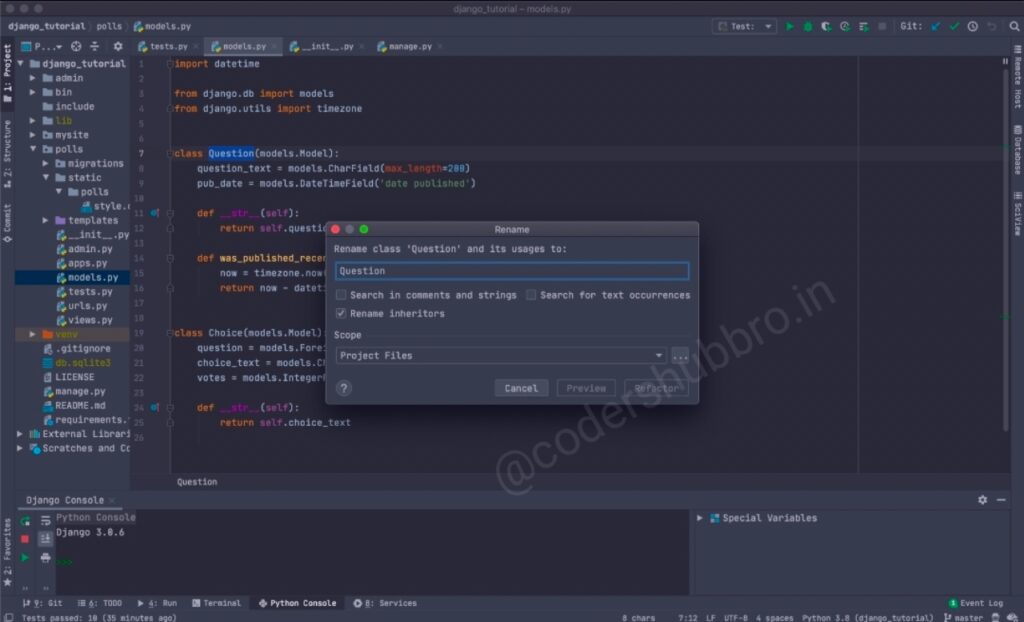
PyCharm is also a very popular code editor designed specially for python programming. This tool can handle even complex programs.
You can use any of them as your code editor but VS Code is highly recommended. Once you install python and choose a code editor, you are ready to start your journey in python for beginners.
Basic syntax of Python
Now you have successfully set up python and its enviroment and the next important step in Python for beginners is to understand the basics of the language. As you already know python syntax is simple and easy to read so it will be very easy and fun for beginners to learn the basics. In the guide Python for beginners, learning how to write basic statements and understands code structures is essentials. Python uses indentation (space at the beginning of the line) instead of brackets to define code blocks and that makes the code look clean and organized.
Variables and data types in Python for beginners
What is variables? Variables are the name of the memory location. It is used to store data in the programs. In python you will commonly work with basic data types such as:
STRING – It is used to store text. (eg: lan = “python”)
INTEGER – It is used to store whole numbers. (eg: num = 34)
FLOAT – It is used to store decimal numbers. (eg: per = 75.5)
BOOLEAN – It is used to store True or False values.( eg: isme = True)
Understanding the variables and data types is the most important concept in python specially for beginners as they are used in almost every programs.
Operators in Python for beginners
Operators in python are used to perform operations on variables and values. There are some common operators in Python that includes:
Arithmetic Operators – (+,-,*,/)
Comparison Operators – (==,!=,>,<)
Logical Operators – (and or not)
Learning how to use operators in python will help you to do calculations and make logical decisions in their programs.
Control statement in python for beginners
After completing the basic syntax of python the next step is to learn control statement. Control statement help your program to make decisions and perform operations and this is essential for writing useful and dynamic code.
In python, control statement mainly include conditional statements and loops. This allow the programmers to know how and why the certain part of code is executed. Control statement are basically used to do something repeatedly without writing code again and again.
Conditional Statements in Python for Beginners
Conditional statements are used when you want your program to make decisions based on certain conditions. In Python for beginners, the most commonly used conditional statements are:
• if statement – Executes code if a condition is true
• else statement – Executes code if the condition is false
• elif statement – Checks multiple conditions
These statements are very important in Python for beginners because they help programs respond differently to different inputs or situations.
if/else statement example:
year = int(input("Enter the year:"))

if (year % 4 == 0 and year % 100 != 0) or (year % 400 == 0):
    print("Leap year")
else:
    print("not a leap year")
elif statement example:
ch = input("Enter the chatracter:").lower()
if (ch in "aeiou"):
    print("Vowel")

elif(ch.isalpha()):
    print("Consonant")
else:
    print("invalid")
Loops in Python for Beginners
Loops are used to repeat a block of code multiple times. In Python for beginners, loops help automate repetitive tasks and make programs more efficient. Loops help us to run a program many times without writing the code again and again. loops are mainly used to do a work repeatedly. There are mainly two loops in python.Loops in Python for Beginners.
The two main types of loops are:
• for loop – Used when the number of repetitions is known
• while loop – Used when the number of repetitions depends on a condition
Understanding loops is a key milestone in Python for beginners, as they are widely used in real-world programming and problem-solving.
for loop example:
for i in range(5):
    print(i)

# Output: 0 1 2 3 4
while loop example:
count = 0

while count < 5:
    print(count)
    count += 1

# Output: 0 1 2 3 4
Functions in python
As you have understand the concept of control statement in python, now the next step is to learn functions. Basically functions help organize code into reusable blocks, making programs easier to manage, read and maintain. Function is a block of code that can be used many times without writing the same code and just calling the function name. Functions improves efficiency and makes programs more structured.
What are Functions in python for beginners?
A function is a block of code that runs only when it is called. In Python for beginners, functions are created using the def keyword, followed by the function name and parentheses. Functions allow beginners to break large problems into smaller, manageable parts. This makes programming more logical and easier to understand.
Why functions are important in python?
Functions are very important in python as they play a crucial role in python for beginners because they:
• Reduce code repetition
• Improve code readability
• Make debugging easier
• Help organize large programs
• Allow code reuse in different parts of a projects
Learning functions is a major step in python for beginners, as they are widely used in real world applications and advanced programming.
function example:
def greet(name):
    return f"Hello, {name}!"

print(greet("Alice"))  # Output: Hello, Alice!
Libraries in python for beginners
Once you understand functions, the next important step in Python for beginners is learning about libraries. Libraries are collections of pre-written code that help you perform complex tasks easily without writing everything from scratch.
In Python for beginners, using libraries can significantly improve productivity and help you build real-world projects faster. Python has a rich ecosystem of libraries that support different fields such as data analysis, web development, machine learning, and automation.
Popular libraries in python
Here are some essential libraries that every beginner should learn.
• NumPy – Used for mathematical operations and working with arrays. This library is used to do complex mathematical operations with ease.
• Pandas – Pandas helps in data manipulation and data analysis. This is used to do data cleaning and other programs.
• Matplotlib – It is used for creating charts and visualization data.
These libraries make Python for beginners more practical and useful, especially for those interested in data science and analytics. Learning how to use libraries is a key step in Python for beginners, as it allows you to work on real-life projects and improve your programming skills.
Practice Projects in Python for Beginners
After learning about libraries, the next important step in Python for beginners is building small practice projects. Projects help beginners apply their knowledge in real situations and improve their problem-solving skills.
In Python for beginners, working on simple projects makes learning more practical and helps you understand how different concepts like variables, loops, functions, and libraries work together.
Simple Project Ideas in Python for Beginners
Here are some beginner-friendly project ideas to start with in Python for beginners:
• Simple Calculator – Create a program that performs basic arithmetic operations like addition, subtraction, multiplication, and division.
• Number Guessing Game – Build a game where the user guesses a random number generated by the program.
• To-Do List Application – Create a basic program to add, remove, and display daily tasks.
• Temperature Converter – Develop a tool that converts temperature between Celsius and Fahrenheit.
• Password Generator – Write a program that generates strong random passwords.
Doing this projects will help you boost your coding skills and knowledge. It is highly recommended in python for beginners because it helps build confidence and strengthens coding skills. At least do two- three projects to boost your skills.
Conclusion
Learning programming can feel challenging at first, but this guide Python for beginners provides a simple and effective way to start your coding journey. With its easy-to-read syntax and wide range of applications, Python helps beginners understand fundamental programming concepts without unnecessary complexity.
In this guide on Python for beginners, you have learned the essential topics to focus on first, including basic syntax, control statements, functions, libraries, and simple practice projects. Building a strong foundation in these areas will help you progress confidently toward more advanced topics such as web development, data science, and machine learning.
The key to success in Python for beginners is consistent practice and continuous learning. By working on small projects and exploring new concepts regularly, you can gradually develop your programming skills and open doors to exciting career opportunities in the technology field.